










Ensuring High Solar Power Quality: Key Factors and Solutions for Effective PV Systems
Understanding Solar Power Quality and Its Impact on PV System Performance
Power quality denotes the set of electrical characteristics of the power supplied by a generation source, ensuring safe and uninterrupted operation of connected equipment. In renewable energy, especially in utility-scale solar PV systems, power quality presents distinct challenges due to their inverter-based generation and variability from environmental conditions.
Key power quality parameters relevant to solar PV projects include:
- Voltage stability: Voltage must be maintained within ±5% per applicable grid codes; European grids often require ±2% voltage unbalance limits as per EN 50160.
- Frequency consistency: The AC output frequency must remain within ±0.1 Hz of the nominal grid frequency (50 or 60 Hz), as required by IEEE 1547 and ENTSO-E network codes.
- Harmonic distortion: Harmonics are quantified by Total Harmonic Distortion (THD), with modern solar inverters targeting THD below 3-5% to comply with IEEE 519 for distribution systems.
- Power factor: Maintaining a power factor close to unity (0.95 lagging to 0.95 leading) minimizes reactive power components that strain grid infrastructure and are regulated by local utility standards.
Solar PV systems differ technically from conventional generators such as fossil fuel or hydroelectric plants in three main aspects:
- Use of power electronics to convert DC generated from photovoltaic modules into grid-compliant AC power, which inherently introduces potential harmonic distortions.
- Intermittent power output variation caused by solar irradiance changes, cloud cover, and atmospheric conditions, resulting in dynamic voltage fluctuations.
- Decentralized installations located close to point-of-use or distribution networks, presenting localized power quality challenges including voltage sags and flicker.
Compliance with these power quality parameters is essential for achieving grid compatibility, system reliability, and minimizing operational risks for commercial renewable energy projects.
Harmonic Distortion in Solar PV Installations: Causes and Mitigation Techniques
Harmonic distortion arises in solar PV systems predominantly from inverter switching and power electronic interfaces. Silicon-based semiconductor switches such as Insulated Gate Bipolar Transistors (IGBTs) operate at switching frequencies in the range of 10 kHz to 20 kHz, producing non-sinusoidal waveforms that introduce voltage and current harmonics into the network.
Key sources of harmonics include:
- Inverter switching devices: Rapid on-off cycling of semiconductor switches causes high-frequency harmonics, primarily odd-order (3rd, 5th, 7th).
- Power electronic converters: Pulse-width modulation (PWM) techniques at various switching frequencies modulate voltage output, potentially generating sideband harmonics.
- Grid resonances: Capacitive and inductive elements within the local distribution system can magnify harmonic levels through resonance phenomena.
Measures to mitigate harmonics in commercial renewable energy PV plants include:
- Implementing advanced inverter modulation algorithms such as Selective Harmonic Elimination (SHE) and Space Vector Modulation (SVM) to minimize switching harmonics.
- Installing passive filters tuned to dominant harmonics (e.g., 5th and 7th) using series LC circuits designed per IEC 61000-3-2 and IEC 61000-4-7 standards.
- Deploying active harmonic filters that use power electronics to inject counter-harmonic currents in real-time to cancel measured distortion.
Typical harmonic content is evaluated against IEEE 519-2014 limits, which set a maximum individual harmonic current of 4% of fundamental current and total harmonic distortion under 5% for distribution networks. Commercial solar PV plants incorporate active power factor correction and real-time harmonic monitoring to maintain THD below 3% continuously, preserving equipment longevity and operational efficiency.
Power Factor Challenges and Correction in Solar Energy Systems
Power factor in solar PV systems reflects the ratio of real power delivered to apparent power consumed. It varies due to inverter operating modes, connected load profiles, and reactive power demands. Maintaining it within 0.95 lagging to 0.95 leading is a common regulatory requirement in European and Serbian grids to avoid grid strain and penalties.
Causes of poor power factor include:
- Inductive and capacitive loads downstream, such as motors and transformers, creating reactive power draw.
- Inverter configurations without reactive power support or static power factor settings.
- Unbalanced phases that produce zero-sequence currents and phase angle deviations.
Consequences of low power factor in distributed solar PV systems involve:
- Penalty charges from utilities based on reactive energy consumption or deviation from agreed interconnection parameters.
- Non-compliance risking disconnection or curtailment under grid codes like ENTSO-E and Serbian grid operator requirements.
- Accelerated wear and thermal stress on transformers, cables, and switchgear resulting from increased current flows.
Correction techniques implemented in commercial renewable energy facilities include:
- Capacitor banks: Fixed or automatic switched units designed according to IEEE Std 18 reduce inductive reactive power locally.
- Synchronous condensers: Large rotating machines providing dynamic reactive power support in utility-scale PV plants over 10 MW.
- Inverter-based power factor correction: Modern inverters execute dynamic VAR control within grid code limits to supply or absorb reactive power in real time.
Adherence to harmonized grid codes like the European EN 50549-1 and Serbian MSS grid requirements mandates reactive power capability ranges typically ±0.95 power factor, supported by firmware settings in inverter controllers.
Energy Storage Systems: Enhancing Solar Power Quality and Grid Stability
stockage d'énergie supplements solar PV to address intermittent generation by buffering power fluctuations and providing ancillary services that improve power quality metrics.
Energy storage technologies integrated with commercial solar PV include:
- Lithium-ion batteries: Energy densities of 150-250 Wh/kg with response times under 100 ms make these dominant for rapid smoothing and peak shaving.
- Batteries à flux : Vanadium redox and zinc-bromine systems offer cycle lives exceeding 10,000 cycles and scalable capacity for multi-hour load leveling.
- Hybrid inverter-storage systems: Combined units simplify control architecture, coordinating inverter islanding, grid synchronization, and battery dispatch in real time.
In a 10 MW commercial solar project like Solar Plus Garden, ESS typically operates charge-discharge cycles on the order of 15 to 60 minutes aligning with solar irradiance variability patterns and short-term grid demand fluctuations. This integration stabilizes voltage deviations within ±2% and frequency swings within 0.05 Hz, contributing to compliance with ENTSO-E ancillary service requirements.
Common Power Quality Problems in Commercial Solar PV Projects and Their Root Causes
Commercial solar PV plants encounter specific power quality problems such as:
- Voltage fluctuations and flicker: Rapid irradiance changes can cause output voltage flicker addressed by IEC 61000-3-7 standards limiting flicker severity (Pst ≤ 1.0, Plt ≤ 0.65).
- Transient disturbances: Occur during inverter start-up, shutdown, or faults lasting milliseconds, measurable by IEC 61000-4-4 surge testing.
- Neutral conductor overvoltage: Sourced from triplen harmonics (3rd, 9th) and unbalanced loads, potentially elevating neutral current to 150% of phase current without neutral sizing per IEEE Std 142 guidelines.
- Thermal effects: Module temperature changes cause resistance variation affecting open circuit voltage and current, impacting power quality indirectly with power coefficient effects typically on the order of -0.4%/°C for voltage.
Addressing these issues requires coordinated system design, harmonic mitigation, proper conductor sizing, and temperature management strategies.
Power Electronics and Inverter Technology: Core Tools for Maintaining Solar Power Quality
Power electronics, especially inverters, convert DC output from solar modules to synchronized AC power with controlled voltage, frequency, and harmonic profile.
Features essential to power quality include:
- Soutien en puissance réactive : Ability to supply or absorb reactive power dynamically, as required by grid codes including IEEE 1547 and EN 50549.
- Grid synchronization: Precise phase-locked loop (PLL) circuits ensure inverter output frequency and phase align with grid standards within ±0.01 Hz.
- Fault ride-through: Capability to maintain operation or implement controlled shutdown under voltage sags/dips per requirements in IEC 62116 and UL 1741 supplements.
Inverter architectures include:
- String inverters: Typically 5-15 kW units serving panel strings, providing flexibility and modular power quality management at panel group level.
- Central inverters: Units exceeding 250 kW for large-scale arrays, enabling aggregated control of voltage, harmonics, and reactive power.
- Micro-onduleurs : Installed at each module, providing individual maximum power point tracking (MPPT) and granular power quality control, though often with higher installation complexity and cost.
Compliance with IEC 62109 ensures inverter safety and reliability, and IEEE 1547 mandates performance metrics including efficiency greater than 98% and total harmonic distortion below 3%, critical for minimizing negative effects on grid power quality.
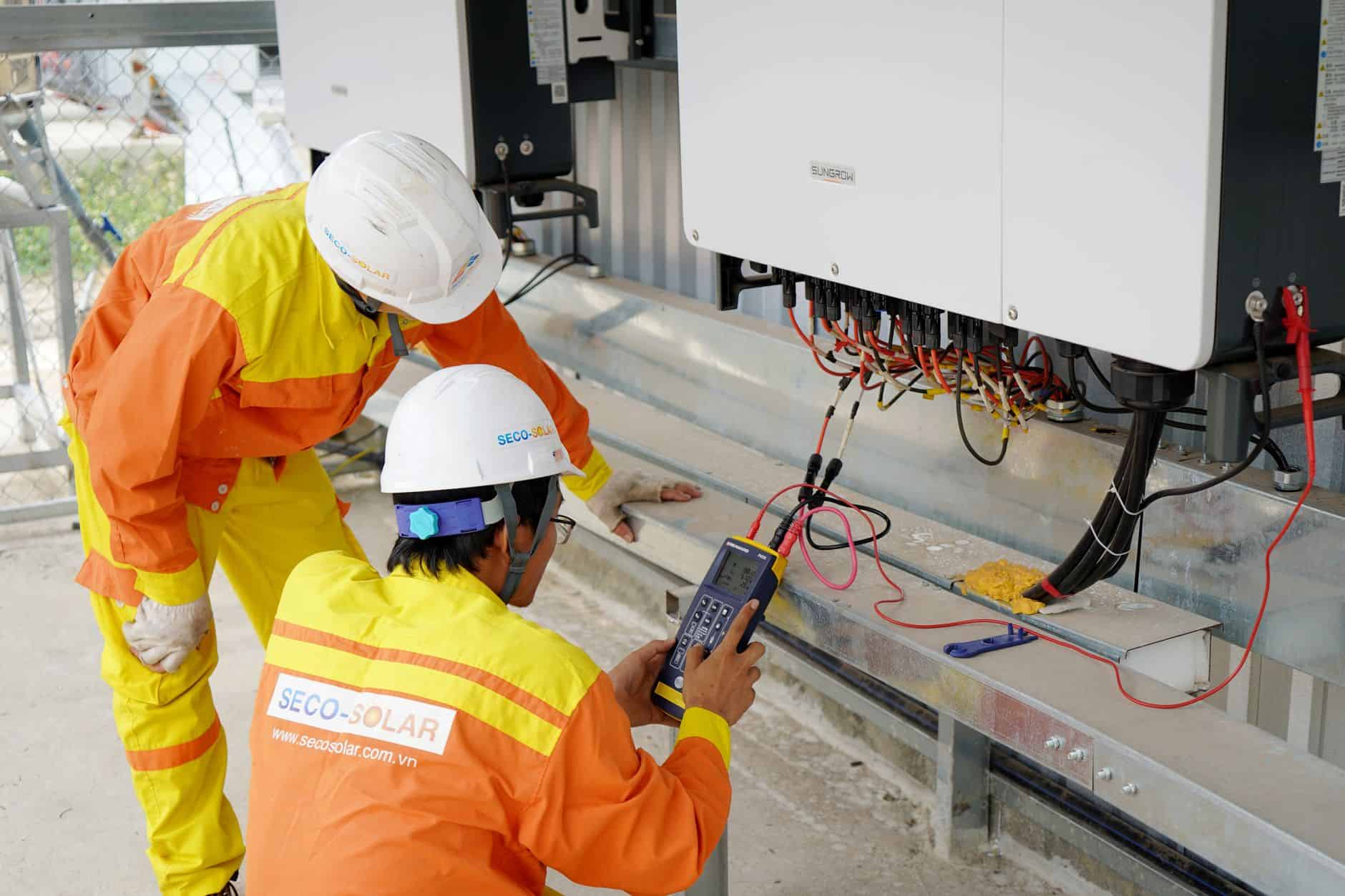
Monitoring and Analyzing Solar Power Quality: Tools and Procedures for Project Developers
Monitoring power quality in commercial commercial renewable energy installations is essential for early detection of deviations and ensuring compliance with standards.
Instruments used include:
- Power analyzers: Devices measuring real-time voltage, current, power factor, and energy flow with resolution typically under 1% error.
- Harmonic analyzers: Equipment capable of capturing harmonics up to the 50th order in accordance with IEC 61000-4-7 methodology.
- Data loggers: Systems storing continuous power quality data in intervals as low as one second, aggregated for reporting at 15-minute intervals matching EN 50160 requirements.
Typical diagnostic procedure for a 10 MW solar plant is:
- Establishing baseline measurements during clear sky, steady irradiance conditions.
- Recording anomalies under variable weather or grid stress events.
- Correlating anomaly timestamps with inverter fault logs and grid utility data.
- Applying corrective measures such as inverter firmware updates, filter tuning, or power factor correction.
- Confirming improvements through follow-up monitoring over a 30- to 90-day period.
SCADA system integration facilitates real-time visualization and alerts, enabling proactive power quality challenge management and operational efficiency.
Power Quality Optimization in Solar Plus Garden’s 10 MW Solar Plant and Community Model
Solar Plus Garden’s utility-scale 10 MW solar PV installation incorporates rigorous power quality management within a dual legal entity framework. The Estonian OÜ legally owns and operates the solar PV plant, while a separate Serbian entity manages the Garden community, clearly segregating asset control and community activities according to regulatory requirements.
Operational financing from Garden membership fees supports:
- Deployment of state-of-the-art power electronics including inverters with reactive power capability and harmonic suppression features compliant with IEC 62109 and IEEE 1547.
- Investment in energy storage systems designed for dynamic power smoothing matching the green energy generation profile.
- Continuous power quality monitoring with adherence to EN 50160 and local grid codes, ensuring voltage deviations remain within ±2%, THD below 3%, and power factor within 0.95 lagging to leading.
This community-backed financial and governance model enables operational transparency and sustainability, supporting scalable agrivoltaïsme with up to 3,000 garden plots drawing consistent power without adverse quality impacts.
Foire aux questions
What power quality problems are most common in solar PV installations?
Solar PV projects typically face harmonic distortion mainly due to inverter switching, voltage fluctuations caused by rapid irradiance changes, low power factor from reactive loads and inverter settings, as well as transient voltage disturbances during inverter startup or shutdown.
How does energy storage improve power quality in solar energy systems?
stockage d'énergie systems stabilize voltage and frequency by absorbing excess solar generation during high irradiance and discharging during low output or peak demand, smoothing short-term fluctuations that affect power quality and grid reliability.
What standards should solar PV projects comply with to ensure good power quality?
Key industry standards include IEEE 519 for setting harmonic current limits, IEC 61000-3-7 for flicker control, IEC 62109 for inverter safety and performance, and IEEE 1547 along with EN 50549-1 for grid interconnection and reactive power management.
How does Solar Plus Garden incorporate power quality management in its 10 MW plant and community model?
Solar Plus Garden employs a legally distinct structure separating the PV plant and Garden community, using member fees to finance advanced power quality technologies, energy storage, and continuous monitoring programs, ensuring compliance with grid codes and stable power delivery to support the community’s agrivoltaic assets.
Conclusion
Maintaining high solar power quality is achieved through focused control of harmonic distortion, rigorous power factor correction, and deployment of advanced power electronics coupled with strategically integrated stockage d'énergie. Adherence to measurement and operational standards such as IEEE 519, IEC 62109, and IEEE 1547 is mandatory for reliable commercial renewable energy PV system functioning.
The Solar Plus Garden 10 MW project exemplifies how transparent legal structuring paired with a adhésion à la communauté financing model supports sustainable, regulatory-compliant solar power generation. Continuous monitoring and investment in inverter and storage technologies will remain necessary to address evolving power quality challenges as penetration of distributed solar PV increases within modern grids.
Lectures complémentaires
- Comprehensive Solar Quality Control: Ensuring High Standards in Solar Panel Production and Inspection
- Intégration des systèmes de stockage d'énergie par batteries (BESS) pour une production d'énergie solaire optimisée et une gestion efficace du réseau
- Optimisation de l'intégration solaire avec les systèmes de stockage d'énergie par batterie (BESS) et les groupes électrogènes (GENSET) pour des systèmes d'alimentation hybrides fiables