









Comprehensive Guide to Solar Investment Venture Capital: Navigating Opportunities and Risks in 2026-2027
Understanding the Landscape of Solar Investment Venture Capital in 2026
Solar investment venture capital is a niche of renewable energy funding that targets early-stage clean technology startups and large-scale solar power projects, accelerating the commercialization of innovations such as solceller systems and integrated energy storage. Venture capitalists provide risk-tolerant capital essential for developing novel solar technology and scaling solar infrastructure, contributing to broader green energy deployment.
Between 2025 and 2026, reported solar venture capital funding globally ranged approximately between €3 billion and €5 billion annually, concentrated predominantly in the European Union and North America. These regions benefit from structured policy frameworks, including government subsidies such as feed-in tariffs, tax credits, and grants which remain subject to national and EU-level regulatory review and consequently influence capital allocation decisions.
Government subsidies influence fundraising rounds by reducing project risk profiles and improving return expectations for investors. For example, feed-in tariffs guarantee fixed payments per kWh for solar power exported to the grid, typically locked in through 15- to 20-year contracts, thereby providing predictable cash flow that underpins financial modeling. Investment trends across venture capitalists increasingly favor solar startups that align with evolving regulatory demands and demonstrate clear pathways to scalable production of solar panels, photovoltaic systems, and energy storage technologies.
- Solar investment: Directed funding into startups focused on photovoltaic systems, energy storage, and solar infrastructure deployment.
- Venture capitalists: Providers of seed funding and later-stage capital to high-potential solar clean technology startups.
- Renewable energy funding: Capital targeted at technologies reducing reliance on fossil fuels, with solar a prominent segment.
- Government subsidies: Instruments such as feed-in tariffs, tax credits, and grants enhancing project economics.
- Investment trends: Shifts in venture capital allocations driven by policy, technology readiness, and market demand.
- Clean technology startups: Early-stage companies developing innovations in solar PV, energy storage, and integrated solutions.
Key Evaluation Criteria for Solar Startups and Projects Seeking Venture Capital
Due diligence in solar investment necessitates detailed technical and financial assessment. Validation of solar technology encompasses efficiency tests aligned with IEC 61215 standards for photovoltaic modules and durability certifications under IEC 61730 for safety. Energy storage solutions, frequently lithium-ion or emerging solid-state batteries, undergo independent cycle life analysis and scalability assessments.
Startup valuation is derived through financial modeling projecting expenses—including capital expenditure (CAPEX) for solar panel installation and operational expenditure (OPEX) for maintenance—and revenue streams based on estimated solar adoption rates and power purchase agreement terms. Models include sensitivity analyses addressing tariff fluctuations and solar irradiation variability at the intended project location.
Project scalability assessment accounts for site-specific factors such as average solar irradiance measured in kWh/m²/day, land zoning restrictions, grid interconnection capacity, and proximity to demand centers. Regulatory stability is evaluated, with emphasis on the durability of incentives and policy support, recognizing that feed-in tariff schemes may be revised every 3–5 years subject to government policies and market conditions.
Environmental impact scoring integrates quantitative assessments of carbon footprint reduction, calculated using lifecycle analysis methodologies compliant with ISO 14040 standards, and alignment with United Nations Sustainable Development Goals (SDGs) relevant to climate action and sustainable communities. Projects are often required to provide Environmental, Social, and Governance (ESG) compliance reports as part of the investment proposal.
Investors typically seek Internal Rate of Return (IRR) thresholds exceeding 8%, alongside qualitative sustainability metrics, to balance financial viability with environmental impact.
- Tillbörlig aktsamhet: Validation protocols including IEC standards for solar panels and energy storage testing.
- Solar panels and photovoltaic systems: Efficiency ratings commonly ranging from 18% to 22% for commercial modules.
- Energilagring: Performance measured in cycle life and depth of discharge metrics.
- Startup valuation: Calculated from discounted cash flow (DCF) models and market penetration forecasts.
- Financial modeling: Revenue projections incorporating tariff schedules and solar irradiance data.
- Projektets skalbarhet: Determined by site irradiation values, land availability up to several hectares, and grid accessibility.
- Environmental impact and carbon footprint reduction: Lifecycle emissions avoided estimated at up to 1.5 tons CO2e per installed MW annually.
- Return on investment: IRR targets above 8%, adjusted for risk and regulatory exposure.
Structure of Solar Venture Capital Funding Rounds and Financial Instruments
Solar startup fundraising follows structured stages adapted to technology development and solar project timelines. Seed funding rounds, usually sized between €500,000 and €3 million, focus on prototype validation, laboratory testing, and initial pilot deployments of photovoltaic systems or energy storage prototypes. Series A funding rounds typically range from €3 million up to €15 million, targeting scaling of production facilities, supply chain expansion, and initial commercial deployment of solar panels and integrated solar power projects.
Later-stage funding rounds and private equity involvement often finance utility-scale installations upwards of several megawatts, addressing full project development and grid connectivity. Capital allocation spans research and development, component procurement, regulatory compliance processes, and marketing activities to promote solar adoption.
Financial instruments include equity shares representing ownership stakes, convertible notes providing debt-equity conversion options tied to valuation milestones, and power purchase agreements (PPAs) that secure revenue through long-term contracts with utilities or corporate off-takers. PPAs typically lock in rates for 10 to 25 years, underpinning cash flow certainty essential for investor confidence.
The Solar Plus Garden platform introduces an innovative medlemskap i gemenskapen funding model, where members pay a one-time membership fee of €200 plus an optional €20 monthly trädgårdslåda subscription. These fees fund solar project development and ongoing community activities, separating solar investment equity from garden membership access, thereby broadening engagement without requiring direct capital investment in photovoltaic assets.
- Seed funding: Early investment stage €500,000–€3 million for validation and pilot solar infrastructure.
- Series A funding: Growth capital €3 million–€15 million targeting scaling of solar panel production and deployment.
- Investment portfolio: Combines equity, convertible notes, and revenue-backed instruments like PPAs.
- Kapitalfördelning: Directed toward R&D, manufacturing scale-up, regulatory approval, and market entry.
- Solar power projects: Operational and in-development photovoltaic arrays sized from kW to multi-MW capacities.
- Power purchase agreements: Long-term revenue contracts securing investor returns under defined pricing conditions.
- Community membership: Membership fees funding solar infrastructure separately from direct equity investments.
Risk Assessment and Mitigation Strategies for Solar Investment Venture Capital
Investment risk assessment covers regulatory shifts, technology obsolescence, market acceptance variability, and financial exposure. Regulatory uncertainty includes possible adjustments to feed-in tariffs and subsidy programs under national frameworks such as the EU Renewable Energy Directive, which can affect project revenues and lifespan assumptions.
Market analysis evaluates competitive factors including advancements in alternative renewable technologies (wind, geothermal), projected energy price trends influenced by global commodity markets, and the rate of solar adoption driven by policy incentives and end-user demand.
Financial risk mitigation uses staged capital deployment linked to milestones such as prototype performance targets, grid connection approvals, and initial power generation metrics. Contracts typically incorporate key performance indicators (KPIs) that trigger subsequent funding tranches, minimizing premature exposure.
Platforms like Solar Plus Garden maintain transparent escrow accounts overseen by dual legal entities—an Estonian OÜ for project ownership and a Serbian DOO for operational management—to segregate funds and enforce strict capital usage protocols. Payment flows are subject to audit and compliance controls, preventing unauthorized expenditures and aligning investor interests with project execution.
Legal structures include clear ownership rights, defined payment schedules, and escrow release conditions drafted in compliance with Estonian and Serbian law, designed to ensure governance, operational transparency, and investor protections operate effectively throughout the investment lifecycle.
- Investment risk assessment: Analysis addressing regulatory, market, and technological risks.
- Solar adoption rates: Projections factoring policy incentives and market acceptance trends.
- Energy efficiency: Incremental technology improvements impacting project competitiveness.
- Market analysis: Evaluation of competitive landscape and energy price volatility.
- Financial modeling: Scenario planning integrating risk-adjusted returns and capital release milestones.
- Escrow model: Secure financial control separating investors’ capital from operational expenses.
- Legal structure: Dual-entity governance ensuring compliance with relevant jurisdictional regulations.
Profiles of Leading Venture Capital Firms Driving Solar Innovation in 2026
Top solar venture capital firms in 2026 focus on funding clean technology startups specializing in solar panels, photovoltaic systems, and energy storage integration. These firms maintain diversified investment portfolios encompassing early-stage ventures and late-stage expansion financing across Europe, North America, and emerging markets.
Private equity and corporate investors increasingly participate in later-stage financing and project-level investments, contributing capital beyond typical venture rounds to scale solar infrastructure and facilitate solar power project deployment exceeding 10 MW capacity.
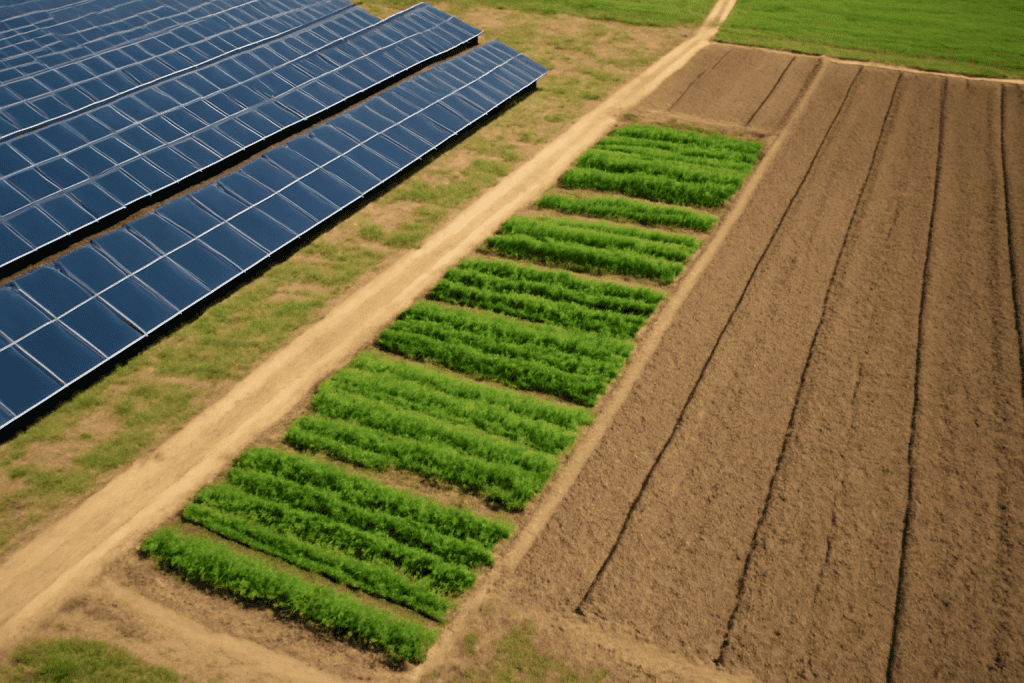
Emerging investment strategies highlight agrivoltaik, integrating solar power generation with agricultural land use to enhance land productivity and sustainability. Community investment models, as embodied by Solar Plus Garden, integrate capital deployment with local impact, blending financial returns and social benefits.
From 2024 through 2026, the leading ten global solar-focused venture capital firms collectively invested over €500 million in solar and agrivoltaics startups, demonstrating concentrated capital flow into next-generation solar innovation and scalable business models targeting climate change mitigation.
- Venture capitalists: Specialized investors shaping solar innovation ecosystems.
- Clean technology startups: Primary recipients of venture funding for solar and storage advancements.
- Private equity and corporate investors: Providers of capital for project scaling and infrastructure financing.
- Solar innovation: Focus areas including improved solar modules, battery technologies, and agrivoltaics.
- Solar project financing: Financial support for utility-scale and distributed solar installations.
- Agrivoltaik: Investment interest in dual-use land synergies between agriculture and solar generation.
- Community investment: Models combining financial returns with environmental and social impact.
How Solar Investment Venture Capital Drives Environmental and Economic Impact
Solar venture capital investments contribute measurable environmental benefits by enabling deployment of solar infrastructure that reduces greenhouse gas emissions. Lifecycle assessments report carbon footprint reductions averaging up to 1.5 tons CO2 equivalent annually per installed megawatt of photovoltaic capacity, depending on regional energy mix and operational parameters.
Economic impact is evidenced by job creation across manufacturing, installation, and maintenance sectors. Expansion of solar adoption stimulates associated supply chains, including silicon wafer production, inverter manufacturing, and battery system assembly, contributing to local economic development and technology transfer.
The integration of solar investment with sustainable development is exemplified in agrivoltaic systems and community-backed schemes. Solar Plus Garden’s combined model links investment portfolios with garden membership fees, enabling generation of clean energy alongside regenerative agriculture and local food production. This dual approach supports comprehensive climate change mitigation goals and promotes community resilience.
- Miljöpåverkan: Verified reductions in carbon emissions through operational solar projects.
- Carbon footprint reduction: Calculated via lifecycle assessments according to ISO 14040 series standards.
- Sustainable development: Alignment with UN SDGs addressing climate action and local economies.
- Solar adoption rates: Indicators of market penetration supporting climate mitigation.
- Investment portfolio: Designed to achieve balanced financial returns and measurable environmental benefits.
Exit Strategies for Solar Venture Capital Investments and Future Market Trends
Exit strategies for solar venture capital typically involve initial public offerings (IPOs), strategic acquisitions by industry players, or secondary buyouts by private equity firms. Timing of exits generally spans 5 to 8 years, contingent upon project scalability, technology validation milestones, and favorable solar adoption market conditions.
Distribution of returns commonly relies on equity appreciation or preferred dividend payouts structured within shareholder agreements. In platforms such as Solar Plus Garden, investors may select between a long-term equity share pathway or a guaranteed payout model, offering flexibility aligned with individual risk profiles.
Future market trends anticipate sustained growth in solar investment driven by ongoing improvements in photovoltaic system efficiencies (now approaching 23% for commercial modules) and advances in energy storage technologies expanding grid integration capabilities. Regulatory frameworks beyond 2027 remain subject to revision, with potential impacts on subsidy mechanisms, grid access protocols, and environmental compliance standards that investors should monitor closely.
Financial modeling for exit valuation incorporates scenario analysis of tariff trajectories, technology cost declines, and demand growth projections to optimize timing and maximize return on investment.
- Exit strategies: IPOs, strategic trade sales, and secondary buyouts as primary liquidity events.
- Return on investment: Equity appreciation and structured payout mechanisms.
- Solar technology: Efficiency improvements contributing to asset valuation.
- Energilagring: Integration enabling expanded market participation and valuation uplift.
- Investment trends: Growth trajectories shaped by policy and technological progress.
- Financial modeling: Forecasting exit valuations under varying regulatory and market conditions.
Vanliga frågor
- What is the minimum investment to participate in a solar venture capital project like Solar Plus Garden?
- Solar Plus Garden allows entry-level investments starting at €500, enabling participation by small and medium investors with transparent processes and regulated financial structures.
- How are community memberships linked to solar investment returns?
- Community membership fees in Solar Plus Garden finance solar power projects and cover ongoing community activity costs. Membership access is separate from direct solar investment, meaning members contribute to community funding without necessarily holding equity positions in solar assets.
- What risks should I consider when investing venture capital in solar startups?
- Primary risks include regulatory changes affecting feed-in tariffs and subsidies, technological obsolescence as newer solar or storage solutions emerge, scalability challenges related to project sites and grid capacity, and market adoption variability. Platforms enforcing transparent escrow accounts and clear legal governance reduce operational risk exposure.
- How does venture capital investment in solar contribute to sustainability goals?
- Venture capital accelerates development and deployment of photovoltaic systems and energy storage, achieving measurable carbon footprint reductions and supporting sustainable models like agrivoltaics. These investments align with climate change mitigation efforts and broader United Nations Sustainable Development Goals.
Slutsats
Investment in solar venture capital requires rigorous assessment of technology readiness, financial projections, market potential, and regulatory environments. Detailed due diligence combined with structured fundraising rounds—from seed funding through series A and later stages—facilitates informed entry and portfolio diversification. Effective risk mitigation relies on transparent legal structures, escrow-backed capital control, and milestone-based funding releases.
Exit strategies should be planned in alignment with projected solar adoption rates, evolving solar technology efficiencies, and regulatory changes. Platforms like Solar Plus Garden offer transparent pathways that integrate solar infrastructure investment with community engagement and sustainable agricultural practices, creating a multifaceted value proposition.
Prospective investors should undertake comprehensive analysis of project documentation, verify legal and financial frameworks, and evaluate membership or direct investment options to align participation with their risk appetite and sustainability objectives.
Relaterad läsning
- Investeringsmöjligheter i solcellsparker 2026: En omfattande guide till investeringar i solenergi
- Omfattande guide till risker inom solenergiinvesteringar och effektiva strategier för att minska riskerna
- Comprehensive Guide to Solar Investment for Beginners: Understanding Opportunities and Community Integration