








Reliable Solar Grid Integration: Technical and Community Insights for Sustainable Power Systems
Impact of Solar Grid Integration on Power Grid Stability and Operation
Solar grid integration introduces operational complexities primarily due to the intermittent and variable nature of solar photovoltaic (PV) generation. Solar power output can fluctuate up to 10% per minute in response to passing clouds, creating ramp rates that require grid operators to manage rapid changes in supply.
These fluctuations affect two critical parameters of grid stability:
- Frequency stability: Because frequency depends on the equilibrium between electrical supply and demand, sudden changes of ±0.1 Hz or more can result from large-scale solar PV variability. Grid operators compensate for these deviations within seconds using ancillary services to avoid cascading outages.
- Voltage stability: Solar inverters can either inject or absorb reactive power, but inconsistent reactive power output may lead to voltage fluctuations of ±5% at distribution level, creating voltage regulation challenges especially in low-load scenarios.
- High solar penetration rates, exceeding a threshold of approximately 20-30% of local grid capacity, increase these stability issues, demanding advanced grid operation techniques such as dynamic voltage control and automatic generation control adjusted for renewable variability.
Coordination between solar system operators and distribution system operators (DSOs) is required at the planning stage to ensure that solar power injections comply with grid operational limits and to implement curtailment strategies or grid upgrades where necessary.
Grid-Forming Inverters: Essential Technology for Stable Solar Power Integration
Solar inverters convert DC voltage from solar PV modules into AC electricity synchronized to grid standards. Traditional grid-following inverters depend on a stable grid voltage and frequency reference, making them unable to regulate grid conditions actively. Grid-forming inverters, instead, generate a stable voltage waveform and provide synthetic inertia resembling that of synchronous generators.
Grid-forming inverters stabilize grid frequency by modulating their output power in response to frequency deviations, typically within ±0.05 Hz. They offer dynamic reactive power support, compensating voltage dips or swells within the range of ±0.1 pu (per unit), which directly counters voltage instability. Phased deployment of these inverters is critical once solar PV penetration passes 20% of grid capacity, as recommended by studies from grid operators in Germany and California.
IEEE 1547-2018 establishes mandatory performance requirements for these inverters, including:
- Synthetic inertia to reduce frequency nadirs during sudden generation or load changes.
- Voltage regulation via reactive power injection or absorption within stipulated timeframes (milliseconds range).
- Ride-through capability enabling continued operation during voltage sags down to 0.5 pu for durations up to 150 ms, ensuring stable grid integration during transient events.
Solar Plus Garden’s 10 MW solar system plans to incorporate grid-forming inverter technology compliant with IEEE 1547-2018 and local grid code requirements, supporting both frequency and voltage stability in the operational region.
Technical Standards and Requirements for Solar Grid Integration
Successful solar energy integration requires compliance with detailed grid codes, technical standards, and regulatory mandates designed to safeguard power quality and safety. For the Solar Plus Garden project, these include:
- ENTSO-E Distribution System Operator Guidelines: defining voltage and frequency limits, fault ride-through, and reactive power capabilities for grid-connected solar PV systems across the European Union.
- Serbian grid codes: specifying local requirements such as mandatory anti-islanding protection according to IEC 62116 and reactive power capability to maintain voltage within ±5% of nominal at connection points.
- IEEE 1547-2018 standard: governing inverter-based resource interconnection performance, emphasizing interoperability and grid support functions.
Mandatory integration technical requirements include:
- Protection schemes: Integrated relay systems following IEC 61850 protocols must isolate faults rapidly (within 100 ms) to prevent damage to grid and equipment.
- Reactive power capability: Inverters must supply or absorb reactive current at a power factor ranging from 0.95 lagging to 0.95 leading, depending on grid operator directions.
- Anti-islanding mechanisms: Solar inverters must cease energizing the grid within 2 seconds of detecting a grid outage to protect line workers and maintain safety compliance.
Solar Plus Garden ensures these standards compliance through factory acceptance testing (FAT), site commissioning tests, and integration studies prior to grid interconnection. Detailed documentation is maintained for regulatory auditing and insurance purposes.
Managing Solar Power Variability with Energy Storage and Demand Response
Mitigating solar PV output variability is critical to sustaining grid stability. Integrating Battery Energy Storage Systems (BESS) with solar PV plants helps smooth power delivery by absorbing excess energy during peak radiation and discharging during solar dips or evening loads.
For the 10 MW Solar Plus Garden plant, BESS capacity is designed at 1.5 MW (15% of installed solar capacity) with an energy capacity of 4 MWh, enabling a discharge duration of approximately 2.5 hours. Lithium-ion battery systems with round-trip efficiency exceeding 90% are utilized, governed by real-time energy management systems to optimize charge-discharge cycles and maximize system lifetime, typically 10-15 years.
Complementary demand response measures leverage automated load control and dynamic pricing to reduce grid stress during low solar output periods. Participating consumers adjust consumption patterns within predefined windows, potentially reducing peak load by 5-10% on critical days.
Integration strategies include:
- Sub-second real-time monitoring of solar generation and storage state-of-charge (SOC) through SCADA systems with telemetry update intervals under 1 second.
- Predictive analytics employing weather forecasts to anticipate solar irradiance variations and preemptively adjust inverter output and storage dispatch.
- Grid-forming inverter functionalities enabling smooth transition coordination between PV-generated power, storage output, and grid supply, minimizing frequency and voltage disturbances.
The Solar Plus Garden Model: Community and Investment Structure for Solar Grid Integration
Solar Plus Garden combines a 10 MW solar power plant with a community gardening concept underpinned by a structured membership model. The separation of the solar asset ownership and the garden operations through distinct legal entities creates a controlled investment environment.
Key financial and operational features include:
- A one-time community membership fee of €200 grants members access to garden benefits without requiring direct capital investment into the solar system.
- An optional €20 monthly subscription to the Garden Box service delivers fresh seasonal produce, supporting the community’s agrivoltaic elements and operational expenses.
- The project’s Estonian OÜ entity legally owns and operates the solar plant, ensuring regulatory and financial compliance specific to solar energy integration.
- Transparent escrow arrangements segregate investment funds for solar infrastructure from operational budgets for community activities, reducing fiscal risks and enhancing investor confidence.
- Small and medium investors engage through regulated financial instruments, consistent with European financial market regulations, aligning with fiduciary transparency and legal clarity.
This hybrid solar-plus-garden model supports solar grid integration while fostering local renewable adoption and sustainable community benefits.
Integrating Agrivoltaics: Maximizing Land Use for Solar and Agriculture
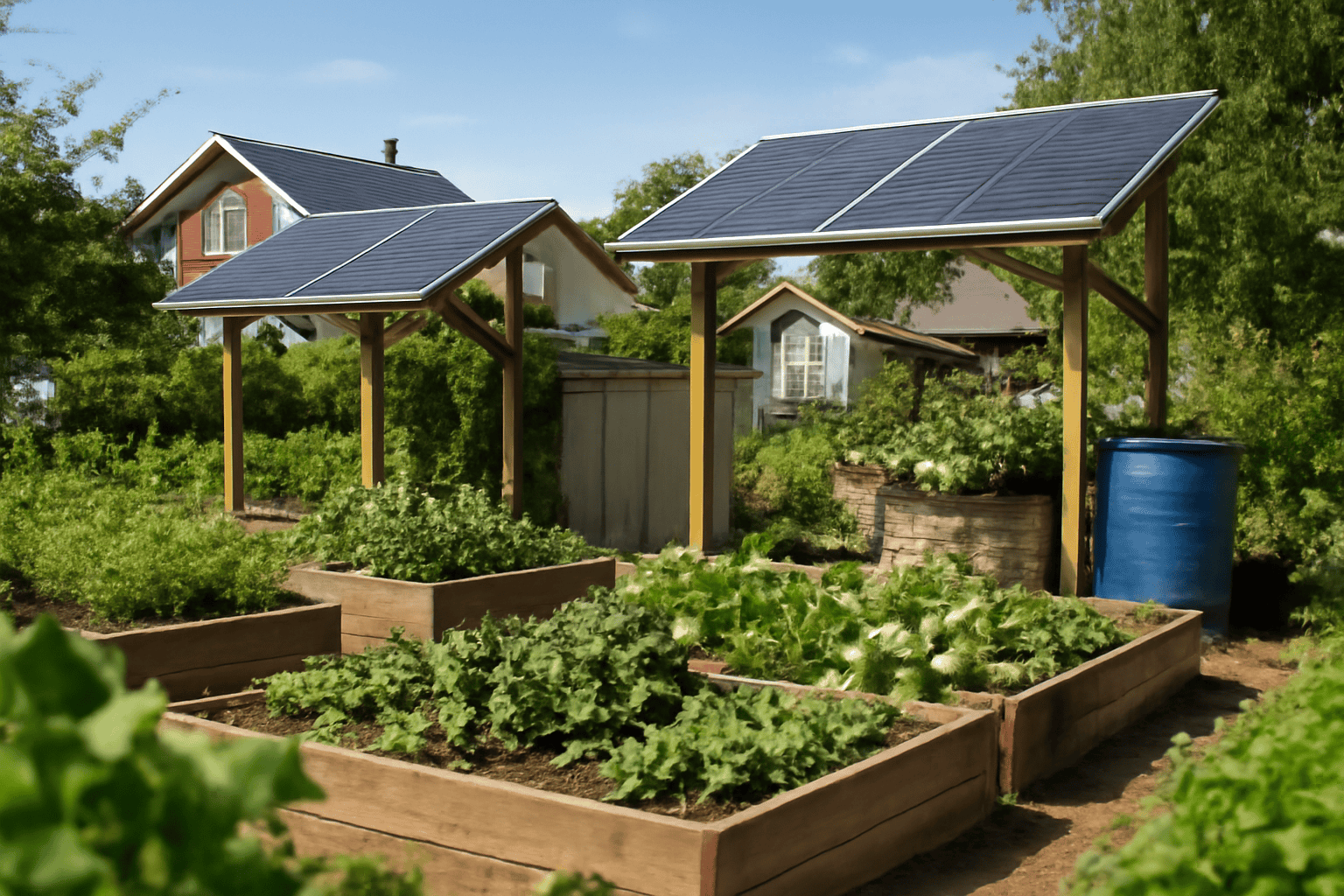
Agrivoltaics is used in Solar Plus Garden to harmonize solar power generation with local crop cultivation, maximizing land efficiency and producing dual outputs.
The 3,000 parcel garden is designed with spatial configurations that optimize light distribution between solar modules and crops. Panels are elevated with a minimum clearance of 2.5 meters and spaced to allow at least 30% diffuse sunlight to reach agricultural plots.
This intentional shading moderates solar irradiation, reducing short-term output volatility by up to 15%, based on irradiance fluctuation studies at similar agrivoltaic sites. It also improves microclimate conditions, reducing soil temperature extremes and evapotranspiration rates, which benefits crop yield stability.
From the perspective of solar grid integration, agrivoltaics:
- Reduces solar PV generation variability by smoothing fast irradiance changes through shading effects.
- Expands renewable capacity within existing land footprints, avoiding the need for additional grid connection points or distribution upgrades beyond the base solar system.
- Enhances social acceptance by providing visible environmental and community benefits, which aids permitting and regulatory support.
Challenges include balancing shading to prevent more than 10% annual energy yield loss, configuring irrigation to avoid panel soiling, and ensuring machinery access for maintenance. These factors are addressed through integrated agrivoltaic design workflows combining agronomy, solar engineering, and grid impact assessments.
Monitoring, Control, and Escrow Frameworks for Transparency and Grid Stability
Effective solar grid integration depends on comprehensive operational monitoring and stringent financial transparence mechanisms.
Operational monitoring uses distributed sensors measuring parameters such as solar irradiance, module temperature, inverter real and reactive power output, and grid voltage/frequency at 1-second sampling rates. Data is aggregated in a SCADA platform enabling fault detection and performance optimization.
Financial transparency follows an escrow payment model where investor funds are held in segregated accounts managed by independent fiduciaries. Deployment of funds into solar infrastructure or community operations occurs only after milestone verification, tracked via Notion documentation and Trello execution boards. This prevents fund commingling and mitigates fiduciary risk.
Investor participation includes rigorous KYC/AML checks consistent with EU and Serbian law, preventing unregulated investments. This control infrastructure supports regulatory compliance and builds trust essential for long-term operation and solar power integration reliability.
Challenges and Constraints of Solar Grid Integration at 10 MW Scale
Integrating a 10 MW solar system with the regional power grid presents technical, regulatory, and infrastructural challenges:
- Inverter lifecycle risks: Typical hardware service life ranges from 7 to 10 years, necessitating planned refurbishment and costing in lifecycle management. Software updates must align with grid code changes and cybersecurity protocols to prevent operational disruptions.
- Regulatory uncertainty: Grid codes and feed-in tariffs might be revised due to policy shifts or evolving grid needs. Such regulatory transitions require flexible operational strategies and financial models to mitigate investment risk.
- Grid capacity constraints: Low-voltage distribution networks often have injection limits around 20% of local peak demand to avoid overload and voltage issues. Utility grid upgrades, including transformer reinforcement or network reconfiguration, may be required, involving additional lead times of 12-18 months and capital expenditures.
Solar Plus Garden’s continuous monitoring of network conditions and engagement with DSOs ensures adaptive operational planning mitigating these constraints while prioritizing grid stability and renewable penetration.
Frequently Asked Questions
What role do grid-forming inverters play in solar grid integration?
Grid-forming inverters actively regulate grid frequency and voltage by providing synthetic inertia and voltage references, unlike grid-following inverters that merely track grid signals. Their compliance with IEEE 1547-2018 enables them to maintain stability even at high solar penetration levels by supporting voltage regulation within ±0.1 pu and frequency within ±0.05 Hz.
How does Solar Plus Garden finance community activities through solar investments?
Solar Plus Garden operates a dual-entity model in which community members pay a one-time membership fee (€200) that finances both solar infrastructure via investment channels and community functions. Ongoing operational costs are supplemented by an optional €20 monthly Garden Box subscription. All funds follow a transparent escrow model to ensure proper utilization and regulatory compliance.
Which grid codes must a 10 MW solar project comply with in Serbia and the EU?
The project adheres to ENTSO-E Distribution Network Codes specifying connection requirements including voltage ranges (±10%), fault ride-through capabilities, and reactive power support. Serbian national grid codes enforce IEC 62116 anti-islanding tests and detailed inverter interoperability requirements with the local distribution system.
What measures mitigate the variability of solar power to maintain grid stability?
Battery energy storage sized between 10-30% of solar capacity with multi-hour discharge capability, demand response programs incentivizing load shifts, and grid-forming inverters providing frequency and voltage regulation collectively maintain stable solar power integration into the grid. Real-time monitoring at sub-second intervals ensures timely adaptive control.
Conclusion
Robust solar grid integration necessitates a combination of advanced inverter technology, rigorous compliance with local and international grid codes, and systems engineering to manage inherent solar variability. Solar Plus Garden’s 10 MW project exemplifies this through the adoption of grid-forming inverters compliant with IEEE 1547-2018, integrated energy storage sized at 15% of solar capacity, and a deliberate community investment model with transparent governance. Continuous collaboration with DSOs and adaptive control frameworks ensure operational reliability amid evolving regulatory landscapes and grid capacity constraints. Stakeholders evaluating solar energy integration projects should prioritize technologies and governance structures that address technical, regulatory, and social dimensions comprehensively to support sustained grid stability and sustainable renewable development.