



Solar Investment Platforms Comparison

Overview of Solar Investment Platforms
Solar investment platforms provide structured access for investors to participate in the solar energy industry without direct management of physical assets. These platforms commonly fall into three categories:
- Crowdfunding platforms: Collect capital from numerous investors to finance solar projects, often returning funds through dividends or interest payments tied to project revenues, typically on a 5-15 year lifespan depending on project financing and contracts.
- Direct equity ownership: Investors acquire shares in solar farms, gaining proportional rights to income from electricity sales and potential voting rights on operational matters for durations extending up to 20-25 years, matching common power purchase agreement (PPA) lengths.
- Community solar models: Individuals pay membership fees or invest to support development of solar projects, accessing community benefits such as subscription to agrivoltaic produce or event participation, often decoupled from direct equity ownership but linked to solar project cash flows.
These platforms lower barriers to entry by enabling investment portfolios to diversify exposure to renewable energy assets starting from modest minimums around €500, as exemplified by Solar Plus Garden. Solar Plus Garden operates through a dual-entity structure—Estonian OÜ for administrative and investor relations functions established on 20.02.2026, and a Serbian DOO that holds the 10 MW solar project assets—ensuring regulatory compliance and legal clarity for investors regardless of domicile.
How Different Solar Investment Mechanisms Work
Mechanisms for investing in solar energy projects vary by risk profiles, return timelines, and investor involvement:
- Crowdfunding mechanisms: Funds are aggregated into a collective vehicle, typically structured as debt or revenue-sharing instruments. Investors receive fixed or variable coupon payments, with terms linked to operational milestones and PPAs that secure electricity sales for 10-15 years.
- Equity-based investment: Investors hold direct or indirect ownership shares, entitled to operational profits after costs. Equity ownership usually entails longer lock-in periods (15+ years), exposure to operational and price risks, and potential upside aligned with solar stock market performance or private project appreciation.
- Community membership models: Membership fees—such as Solar Plus Garden’s €200 one-time fee plus an optional €20 monthly Garden box subscription—underwrite solar project development and community agrivoltaic activities. Membership does not confer equity rights but links financial support with non-financial benefits like access to local organic produce and events.
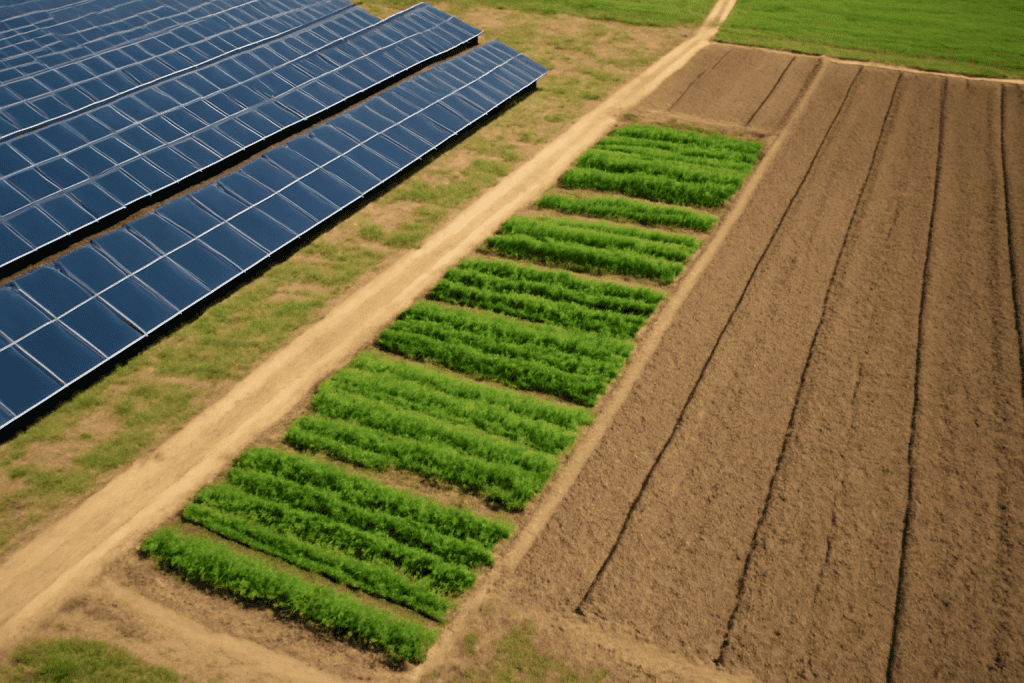
Solar Plus Garden applies this dual model: the Serbian DOO owns and operates the 10 MW solar farm using photovoltaic (PV) modules expected to deliver stable electricity output monitored via SCADA systems, while the separate garden membership entity manages up to 3,000 plots for agrivoltaic produce cultivation under controlled conditions. This approach supports diversification within a single portfolio by combining revenue-generating solar assets and community engagement.
Cost Structures and Fees in Solar Investment Platforms
Transparent and well-defined cost structures are critical for evaluating solar investment platforms:
- Membership fees versus upfront investments: Platforms like Solar Plus Garden separate community membership fees from direct capital invested in solar projects, requiring a €200 one-time membership fee plus an optional monthly €20 subscription for garden box deliveries. The minimum solar investment starts at €500, distinct from these community fees.
- Management and escrow fees: Platforms typically charge annual asset management fees around 1-2% of invested capital to cover asset oversight, administration, and investor relations. Use of escrow accounts governed by independent custodians ensures funds are disbursed only upon reaching predefined milestones, such as construction completion or regulatory certification.
- Community program funding: Separate from core solar investments, fees collected for garden memberships finance operational costs of agrivoltaic cultivation, local distribution logistics, and community events, maintaining clear financial separation to prevent cross-subsidization.
- Fee transparency and control mechanisms: Solar Plus Garden enforces rigorous escrow and payment controls without reliance on “escrow-like” informal arrangements, supported by documented workflows and audit trails. Investors receive periodic statements detailing the use of funds and are protected from unauthorized spending.
Risks Associated with Solar Energy Investing
Solar energy investment shares risks typical for renewable infrastructure sectors, including:
- Regulatory and legal compliance: Cross-border structures, like Solar Plus Garden’s Estonian OÜ combined with Serbian DOO, necessitate compliance with EU renewable energy directives, Serbian local regulations, tax laws, and financial reporting standards such as IFRS or local GAAP, influencing investor returns and reporting obligations.
- Market and policy risk: Income streams derive largely from feed-in tariffs, PPAs, or wholesale electricity market prices, subject to government policy revisions or market dynamics expected to evolve in 2026-2027, impacting revenue stability and payback periods.
- Operational risk: Solar farm output depends on panel efficiency (typically 18-22% for commercial PV modules), inverter reliability, maintenance protocols, and weather conditions impacting irradiance. Downtime or performance degradation can reduce expected yields.
- Liquidity and exit risk: Solar investments often involve fixed-term contracts with limited secondary markets. Investors should evaluate exit options, such as anticipated buyback mechanisms or platform liquidity provisions, before committing capital.
Solar Plus Garden mitigates these risks by withholding investor onboarding until full regulatory clarity is established, applying a dual-entity governance model and escrow-controlled payments. Though returns depend on tariff stability and operational efficiency, the platform’s legal and operational clarity supports investor confidence aligned with a long-term solar investing horizon.
Step-by-Step Guide to Joining a Solar Investment Platform
The typical process involves:
- Registration and KYC/KYB verification: Applicants provide identification and corporate documentation as required by anti-money laundering (AML) and counter-terrorism financing (CTF) regulations, usually completed within 48-72 hours.
- Investment selection: Investors choose their preferred product—equity shares in solar farms, debt-based crowdfunding, or community membership—guided by risk-return profiles, investment horizon, and liquidity preferences.
- Funding and escrow process: Payments are made into regulated escrow accounts with disbursement contingent upon achieving project milestones or membership activation thresholds. Solar Plus Garden follows a process involving a €200 activation fee and optional ongoing €20 Garden box subscription.
- Community benefits and reporting: Members receive periodic solar project performance reports compliant with IFRS, alongside agrivoltaics produce deliveries and invitations to community events fostering engagement beyond financial returns.
- Ongoing monitoring: Investors access online dashboards showing real-time SCADA data for solar farm output and financial reporting, supporting transparent portfolio management.
Solar Plus Garden additionally provides an affiliate program with a 4-step sign-up: submit application, approval within 48 hours, escrow payment, membership activation, and ongoing community participation, supporting a structured investor journey with documented timelines and controls.
Comparative Analysis of Leading Solar Investment Platforms
Key comparative factors include:
- Minimum investment thresholds: Solar Plus Garden’s €500 entry compares favorably with platforms that require €1,000 or more, enhancing accessibility for retail investors.
- Return mechanisms: Crowdfunding platforms often provide fixed loan interest typically in the 4-7% annual range, variable by project risk and PPA terms, whereas equity-based solar stock options depend on electrical generation profitability and market conditions, yielding potential capital gains and dividend streams.
- Transparency and compliance: Leading platforms furnish audited financial statements, detailed project documentation, and regular investor reports adhering to EU securities regulations. Solar Plus Garden’s legal structure ensures compliance with Estonian and Serbian regulatory frameworks.
- Community integration: Platforms incorporating agrivoltaics or community solar provide additional benefits; Solar Plus Garden’s membership supports up to 3,000 garden parcels, blending solar stock exposure with access to fresh, locally grown organic produce.
- Investor protection: Investment vehicles structured as regulated Estonian OÜs combined with local Serbian operating entities clarify ownership, regulatory oversight, and protect against legal ambiguities common in cross-border solar investing.
Local Market Considerations for Solar Investments in Europe
Investing in European solar projects requires understanding:
- Regulatory compliance: Solar Plus Garden’s Estonian OÜ aligns with EU Directive 2018/2001 (Renewable Energy Directive), while the Serbian DOO complies with Serbia’s Law on Renewable Energy, creating a compliant framework for cross-border energy investments established in early 2026.
- Feed-in tariffs and incentives: Feed-in tariff rates in Serbia and Estonia differ and are subject to government review cycles expected in late 2026 and 2027, influencing project cash flow projections and payback calculations for investors.
- Currency and taxation: Investments are subject to currency risk between the Euro and Serbian dinar (RSD). Cross-border tax considerations include withholding taxes and VAT implications, which vary depending on investor domicile and applicable double taxation agreements.
- EU policies for community solar and agrivoltaics: Current EU strategies promote integrated solar-agriculture models, supporting platforms that combine solar stock investing with agrivoltaic community benefits to qualify for potential future incentive schemes.
Future Outlook and Trends in Solar Investment Platforms
Over 2026-2027, investment in solar energy is influenced by:
- Growth of agrivoltaics integration: Emerging evidence demonstrates that combining PV installations with agricultural production can increase total land productivity by 15-25%, aligning investor financial returns with community and environmental impact.
- Movement towards regulated platforms: Investor demand is driving adoption of platforms with audited reporting, legal clarity, and documented compliance, shifting away from informal crowdfunding to structured vehicles supported by established legal entities.
- Technological advances: Improvements in bifacial PV modules, energy storage integration, and IoT-based remote monitoring are enhancing efficiency and reducing operational costs on modern solar farms, extending asset life and stabilizing returns.
- Regulatory changes: Anticipated revisions in feed-in tariffs, subsidy frameworks, and environmental compliance may alter risk profiles and expected payback periods, necessitating adaptive portfolio management strategies.
Solar Plus Garden aligns with these trends by combining 10 MW solar capacity with a scalable Garden membership program delivering both solar stock exposure and agrivoltaics community benefits, designed for sustainable scalability matching evolving regulatory and technological environments.
Frequently Asked Questions
- What are the minimum investment amounts commonly required on solar investment platforms?
- Minimum amounts typically start at €500 on accessible platforms such as Solar Plus Garden, facilitating entry-level exposure to solar farms and enabling small to medium investors to diversify their portfolios within the solar energy industry.
- How does a community solar membership differ from direct solar project investment?
- Community solar membership involves payment of membership fees to support solar projects and access benefits like locally grown produce or event participation. This contrasts with direct investment, where investors acquire ownership shares or stock in solar farms with financial return entitlements.
- What legal structures protect investors on cross-border solar investment platforms?
- Effective platforms use transparent, dual-entity models such as Solar Plus Garden’s Estonian OÜ for administrative and investor relations and Serbian DOO for operational asset ownership, ensuring compliance with multi-jurisdictional laws and reducing investor risk.
- Are there additional costs beyond the initial investment on solar platforms?
- Yes, platforms may charge one-time membership fees (e.g., €200 for Solar Plus Garden) and optional subscriptions (e.g., €20 monthly Garden box). Management and escrow fees also apply, all transparently defined and controlled to prevent unauthorized expenditures.
Conclusion
When evaluating solar investment platforms, prospective investors should assess minimum investment requirements, legal structures, cost transparency, return mechanisms, and community engagement opportunities. Solar Plus Garden offers a distinct approach by combining a 10 MW solar project with a community agrivoltaics membership supporting up to 3,000 parcels, creating diversified exposure to solar stock alongside tangible local benefits. Aligning investment decisions with individual risk tolerance, portfolio diversification goals, and interest in sustainable community involvement is essential. Prospective investors ready to invest should prioritize platforms with clear regulatory compliance, transparent fees, and comprehensive reporting to navigate the evolving solar energy industry landscape through 2026-2027.
Related reading
Related: How investing through an authorised ECSP platform works — the regulatory route Solar Plus Garden plans to use, including how to verify a platform’s licence yourself.